
Job growth was uneven during the Second Quarter 2026, with a 115,000 gain in April, a 172,000 gain in May and a 57,000 gain in June, resulting in an unemployment rate of 4.2% in June. Hiring remains concentrated in a handful of sectors, including health care and social services. Job weakness was most pronounced in leisure and hospitality, despite preparations for the World Cup. Job creation in other blue collar and white collar sectors was frozen. According to Guy Berger, senior fellow at the Burning Glass Institute, “The labor market is probably, slowly, heading in the right direction. But at this current pace, it's going to take a long time to unwind the moderate amount of damage from the last few years. And something could knock that off course.”
The U.S. Bureau of Labor Statistics released the May 2026 Consumer Price Index on June 10, with headline CPI rising 0.5% month over month and 4.2% year-over-year, the highest annual reading since April 2023 and up from 3.8% in April. Core CPI rose a more modest 0.2% in May, with annual core inflation ticking up to 2.9% from 2.8%, the highest since September 2025.
The U.S. Census Bureau released its advance estimate of retail and food services sales for June 2026 on July 16, showing total spending up 6.7% from a year earlier, driven mostly by gas price increases (5.4% excluding gasoline stations). Sales growth slowed on a month-over-month basis in June to 0.2%, according to the U.S. Commerce Department, as gas prices declined. Even though consumer spending has held up relatively well, nearly 60% of personal outlays are concentrated among the top 20% of earners. Generally, households have offset higher costs by drawing down savings, using more credit and benefitting from tax refunds.
The impact of higher borrowing costs and higher energy costs has impacted the Greater Washington, D.C. economy negatively, according to Ian Anderson, CBRE’s senior director of research and analysis, and his REVIVE Regional Vibrancy Index. Per Anderson, “Overall the region just continues to be in this ‘muddling through’ phase. It’s just like two steps forward, one step back, two steps forward, one step back, two steps backward, one step forward.” Anderson feels that the region’s job market, which took a big hit from federal cuts, is “starting to turn a corner,” with the total number of people employed in the region increasing by 0.2% in March and 0.1% in April.
Given the economic uncertainty, off-price retailers and thrift stores continued to experience increased traffic, as consumers sought value and treasure-hunt experiences. Per Cushman & Wakefield, value-oriented retail is best positioned for growth. According to The New York Times, retailers like Walmart, Target and Dollar General are among those investing in remodeling thousands of existing stores even as more shopping happens online. At least $20 billion is budgeted to remodel over 12,000 stores this decade. Per Target’s Michael Fiddelke, the company’s CEO, “By investing in new stores and remodels, we’re elevating the Target experience.” Luxury brands also are committed to brick and mortar, as physical stores remain the dominant channel. According to Rachel Daydou, EY Studio+ France luxury, AI and sustainability leader, “The store is still the cornerstone and the preferred purchase channel and the one that delivers the best experience.” Daydou indicates that 44% of surveyed customers indicate that they choose in-store because of the “pampering experience.” Customers select spaces where they feel most recognized, guided and reassured.
Placer.ai notes that open-air shopping centers experienced a 4.7% year-over-year increase in traffic through June, the highest among retail formats. Audience analysis indicates that the gains are coming from an increasingly diverse customer base, which suggests that centers are broadening their appeal through co-tenancy, attracting more value-conscious shoppers. A combination of retail, dining, entertainment and one-stop convenience may help centers resonate with a broader audience in an environment where consumers remain selective about discretionary spending.
The expanding definition of value applies to the dining sector as well, where consumers seek quality, convenience and experience in addition to affordability. Year to date dining traffic saw a sustained decline, with the exception of the month of February, which saw a 3.7% increase in visits. Quick serve restaurants have suffered most of this decline, as rising menu prices and inflation have weakened the segment’s cost-based value proposition and grocery stores and superstores have stolen market share in addition to traditional restaurant rivals. Meanwhile, fine dining has posted traffic growth in nearly every month of 2026, with the exception of March and fast casual and casual dining also have proven resilient. In general, the strongest performers have found ways to deliver value through menu innovation, loyalty engagement, differentiated experiences, service and atmosphere.
Retail Net Absorption Bounces Back
After a slow first quarter, retail net absorption in the United States turned positive in Q2 2026, with 708,000 square feet.

NEWS | RESEARCH
Q2 2026 White Paper
Brick & Mortar Retail Remains Flat as Economic Uncertainty Continues

Retail leasing net absorption rebounded during the Second Quarter 2026 amidst hopes that the war with Iran would end and gas prices would decline. Although consumer sentiment continued at historic lows, more affluent consumers drove retail sales slightly higher. Investment activity slowed relative to the First Quarter, but institutional investors dominated bidding at more aggressive pricing in the transactions that proceeded.
Consumer Confidence Wanes in Face of Higher Inflation
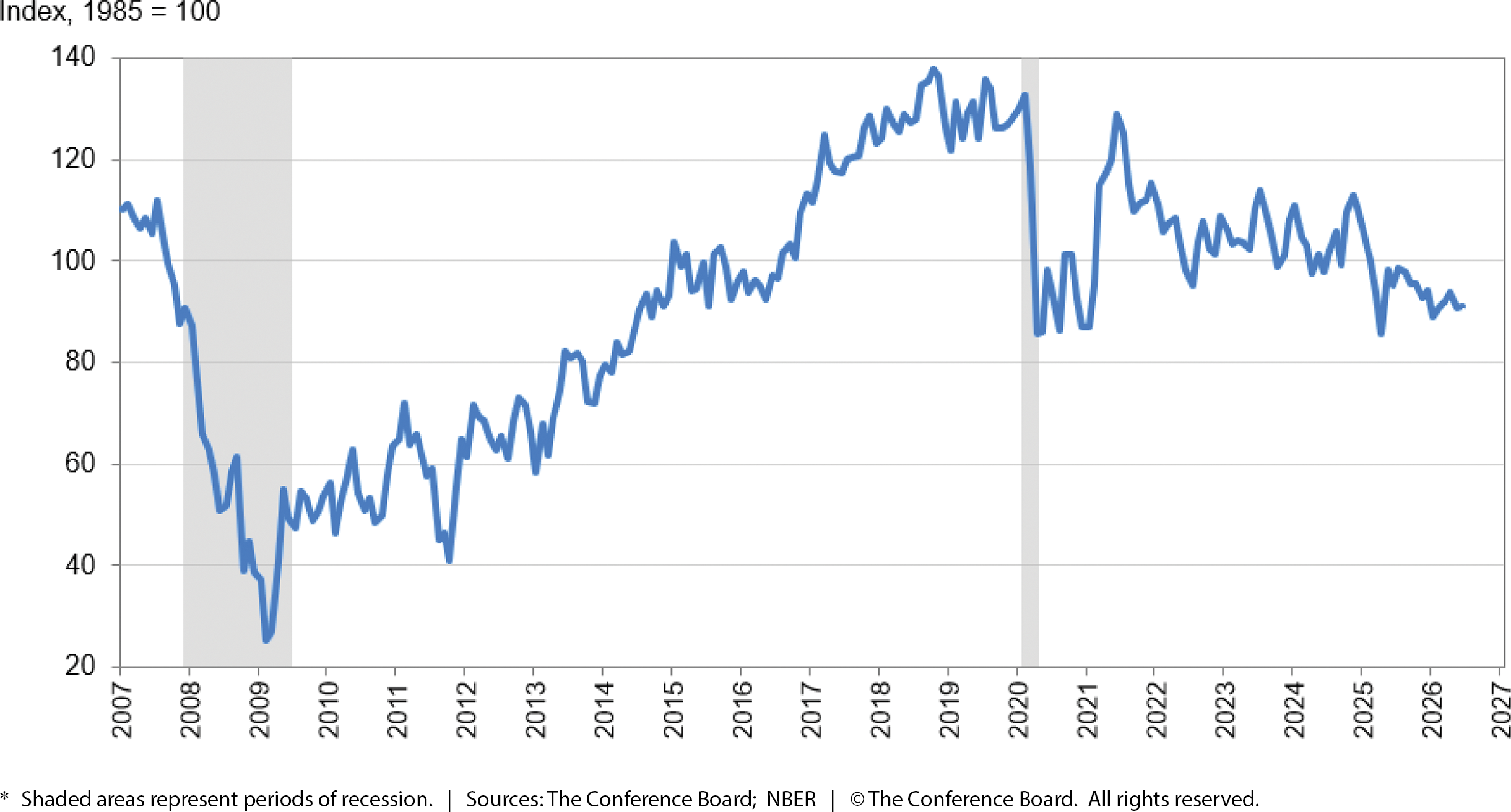
Lower gas prices and inflation buoyed U.S. consumer confidence in June, which was up relative to May. According to the University of Michigan Consumer Sentiment Index, sentiment is still 13% below January 2026 and 19% below a year ago. According to Dana M. Peterson, Chief Economist for The Conference Board, “Consumer appraisals of current business conditions were slightly more positive compared to last month. However, perceptions of the current labor market softened measurably as the percentage of consumers saying jobs were ‘hard to get’ rose to 22.5%, the highest level since January 2021. Moreover, consumers anticipate little change in the labor market six months from now….” The Conference Board’s Present Situation Index declined in June and its Expectations Index improved.
CONSUMER CONFIDENCE INDEX
SHOPPING CENTER NET ABSORPTION
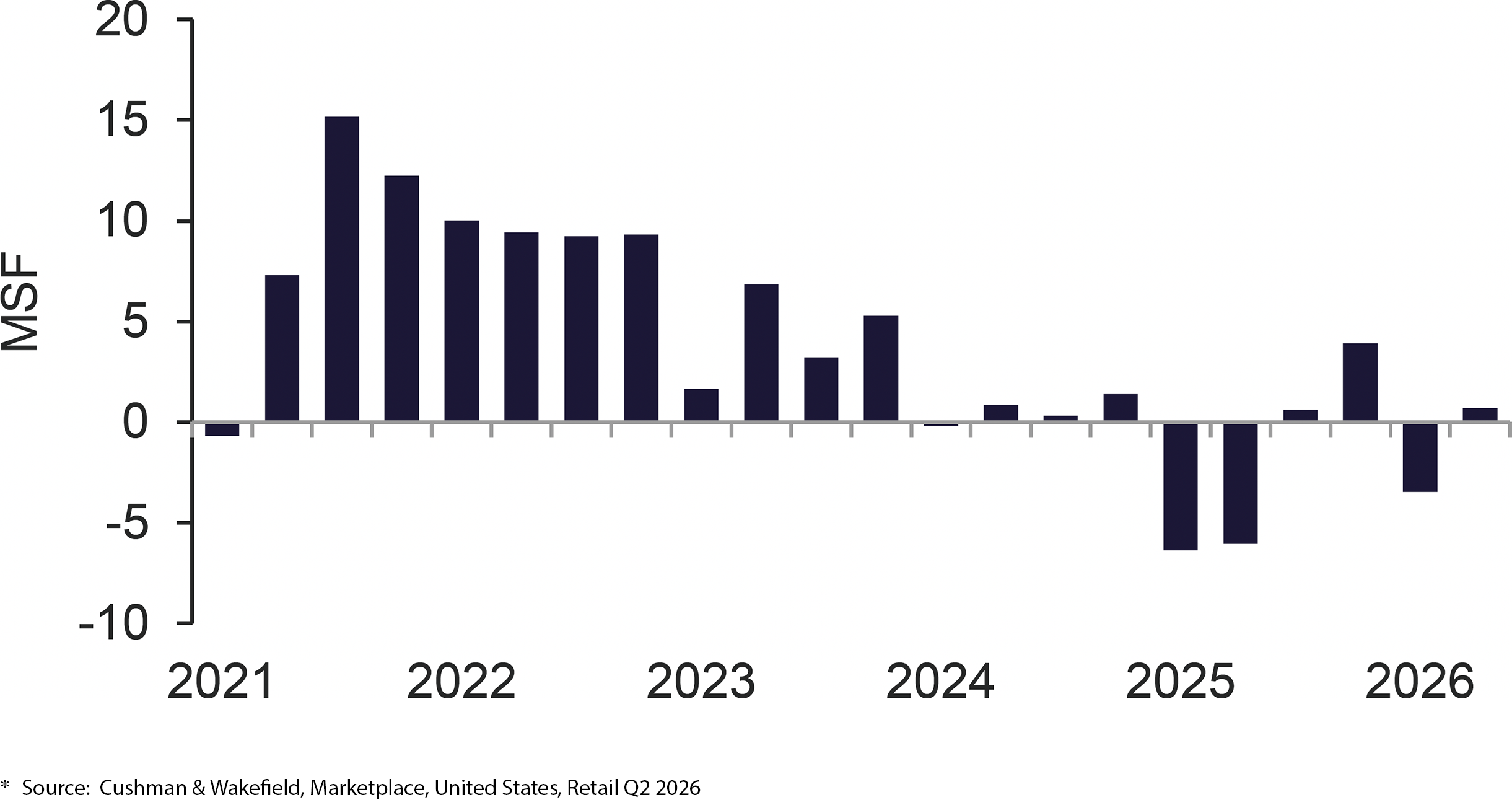
Leasing activity occurred amidst continued supply side constraints, as only 2.3 million square feet was delivered during Q2 2026 and 13.3 million square feet remains under construction. Notably, 87% of the new deliveries were neighborhood and strip centers (Approximately 25% of total U.S. retail inventory is in grocery-anchored neighborhood centers). Significant growth in supply is not foreseeable in the near future, as already high construction prices are expected to increase further due to the energy shock and general inflation. Debt costs are not expected to decrease significantly and may increase, subject to Fed policy, the bond markets and general market uncertainty.
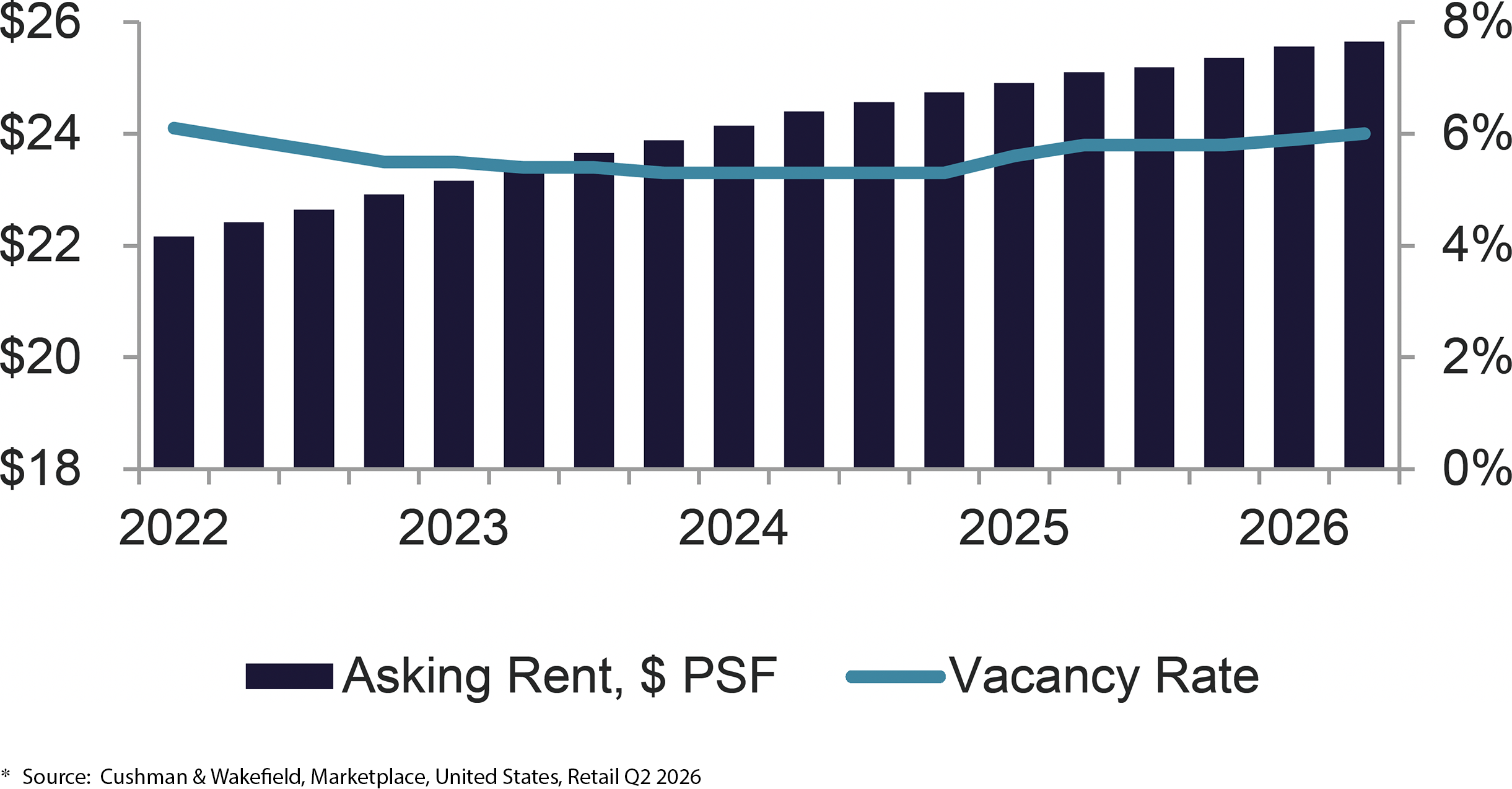
Q2 2025 vacancy ended at 6.0%, up slightly from 5.9% at the end of the First Quarter (Lee & Associates reported Q2 vacancy at 4.4%, including all formats). According to Cushman & Wakefield, asking rents in Q2 2026 averaged $25.65 per square foot, up from $25.48 per square foot at the end of Q1 2026, and representing 2.2% year-over-year rent growth (Lee & Associates reported average rent at $26.04 per square foot). According to Brandon Svec, national director or retail analytics at CoStar Group, slowing retail rent growth is a function of normalization. He states, “While rent spreads have moderated somewhat from the record levels achieved in 2022 through 2024, they remain near multi-decade highs in many markets as rents on expiring leases often sit well below current market rates. The combination of elevated lease spreads and larger contractual rent escalations is allowing many owners to continue generating meaningful revenue growth even as rent appreciation slows.”
OVERALL VACANCY AND ASKING RENT
Washington, D.C. Metro Performs in Line with National Statistics
Based upon data presented by Cushman & Wakefield, Washington, D.C. metro area retail trends are in line with national figures. It estimates the metropolitan area open-air retail center Q2 2026 vacancy rate to be 5.4% (Lee & Associates reported 4.5%), with asking rents of $35.89 per square foot (Lee & Associates reported $35.40 per square foot), 481,126 square feet under construction and an in-place inventory of 119.9 million square feet. Cushman & Wakefield reports -290,792 square feet of net absorption for Q2 2026 for open-air retail in the Washington, D.C. metropolitan area.
Retail Investment Sends Mixed Signals Amidst Rising Interest Rates
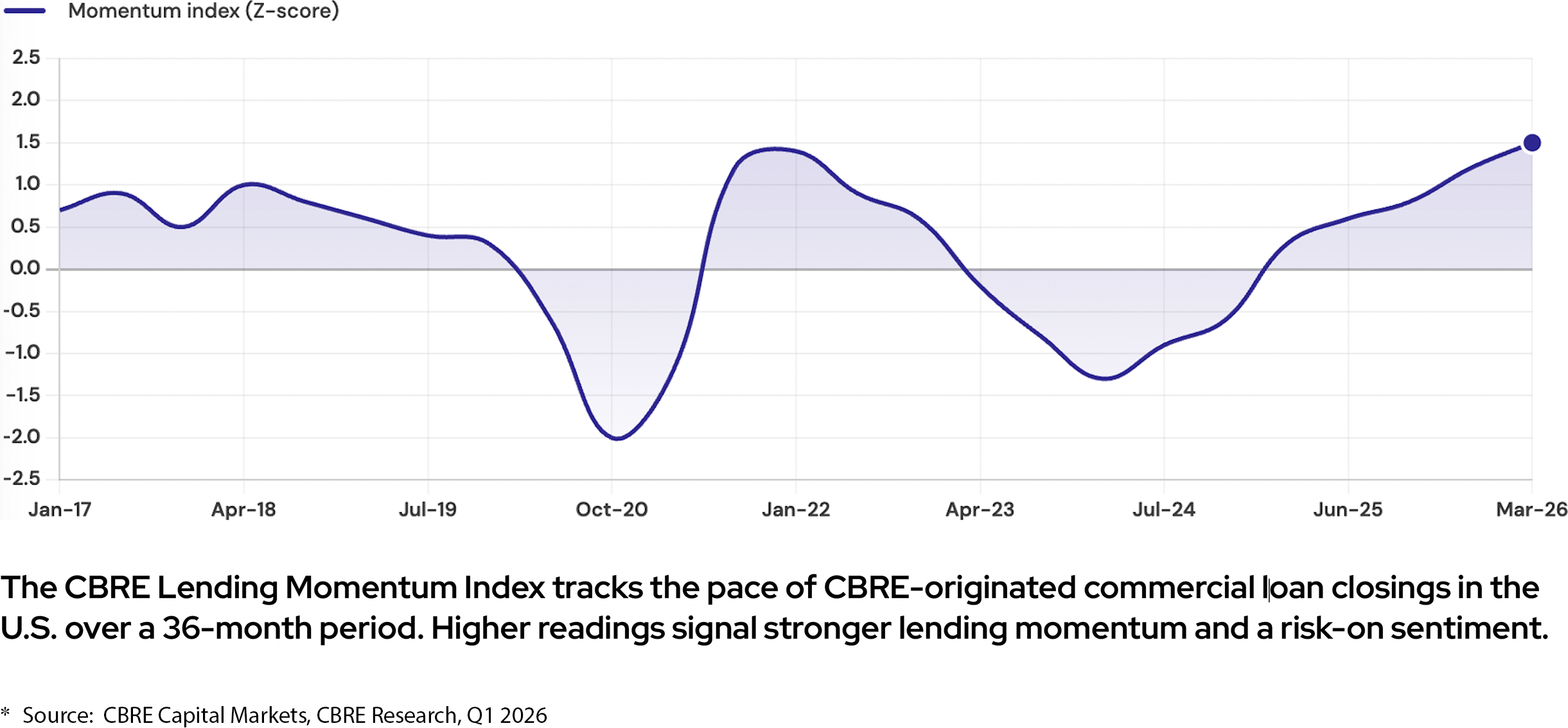
U.S. retail investment sales and debt markets sent mixed signals during Q2 2026, as lending activity rose and investment activity slowed. According to the CBRE Lending Momentum Index, commercial real estate lending activity climbed to its highest level since 2021. CBRE attributed this to higher average loan sizes, more non-agency loans, relatively stable spreads and improved loan-to-value ratios. JLL Capital Markets CEO Richard Bloxam calls it a “hyper-competitive financing environment.” Meanwhile, retail CMBS delinquencies have been on the rise, with the Trepp Delinquency Rate increasing by 30 basis points on retail loans to 6.91% in June.
LENDING MOMENTUM INDEX
At the same time, commercial real estate sales volume was down 33% during the Second Quarter, a marked change from the 27% growth in transaction volume during the First Quarter (Retail asset sale volume was down 15% - 20%). Per Bisnow, the number of bidders on commercial real estate sales also has been sliding lower. According to JPMorgan Chase analysts, the upward march of the 10-year Treasury yield and the lower likelihood of near-term rate cuts contributed to this downshift, writing, “When combined with the big moves in interest rates in the last few weeks, capital markets are turning into a potential risk looking into 2H for which continued strength is expected.”
GLOBAL BID AND CREDIT INTENSITY INDICES
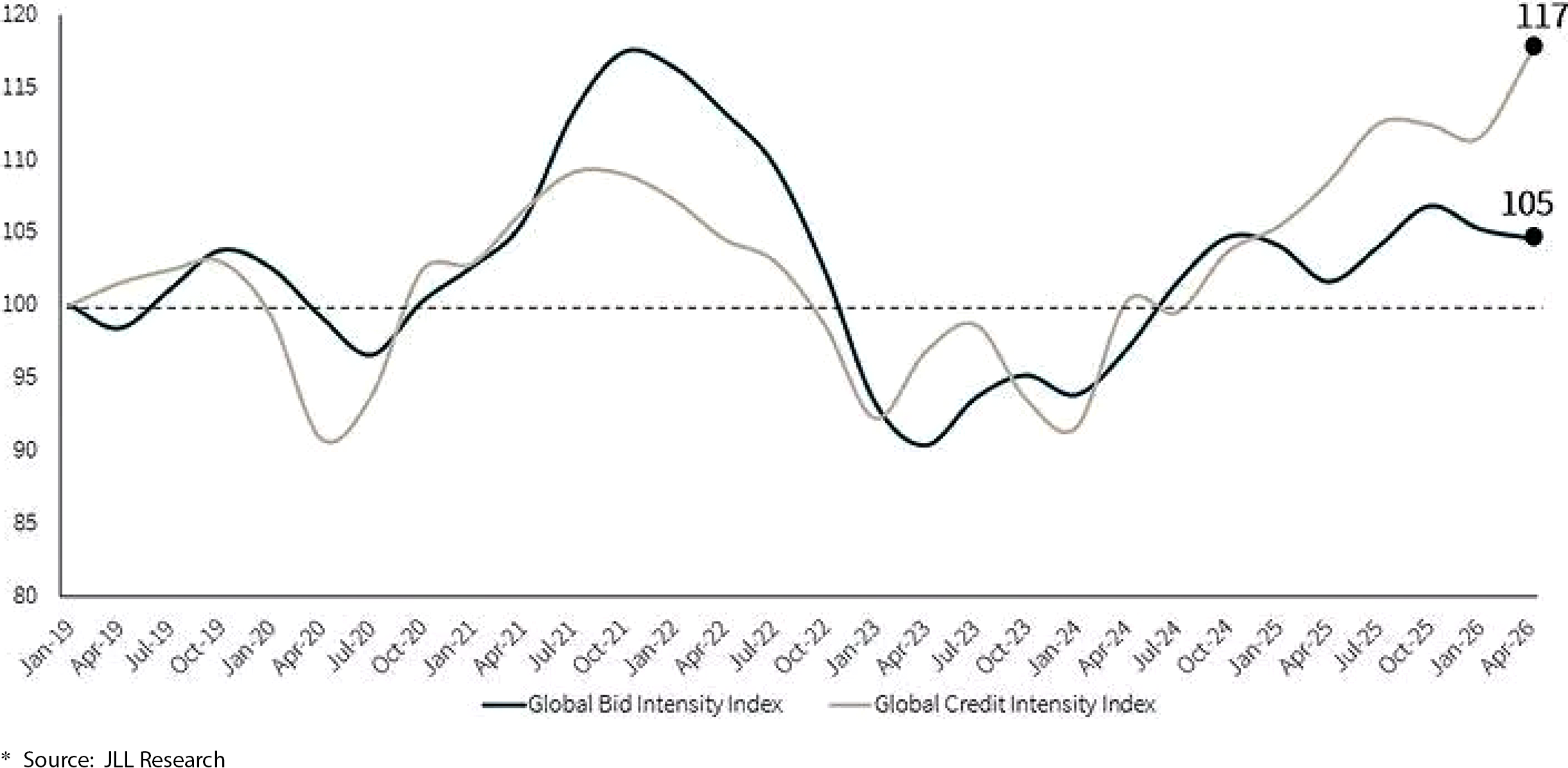
According to Altus Research, retail transactions distinguished themselves from those of other property types by the fact that a majority of transaction volume (54.5%) came from deals between $1 million to $10 million, whereas all other traditional sectors saw 57% of volume from deals exceeding $10 million. Some research indicates that pricing remained flat in Q2 2026. According to Peter Rothemund, co-head of strategic research at Green Street, “Price gains have been modest because cap rates continue to be quite sticky. And it’s unlikely that things change over the near term. Interest rates are high enough that pricing is likely to remain in a tight range.”
At the same time, Green Street acknowledges that the picture is more varied on a property type basis and interest continues to run high for open air retail centers. Institutions continue to join forces with operators to invest in the sector. During the Second Quarter, TPG Real Estate, PSP Investments, La Caisse and Norges Bank Investment Management endorsed U.S. grocery-anchored real estate by acquiring Echo Realty, a full-service operator of more than 230 retail centers across the Midwest and Southwest in a transaction that was valued at approximately $2 billion. According to Rana Ghorayeb, head of real estate at the Quebec-based pension fund La Caisse, “By partnering with TPG and other like-minded global institutional partners to acquire Echo, we are strengthening our exposure to high-quality established platforms with attractive fundamentals.” Similarly, Bain Capital continued its investment in grocery-anchored shopping centers during the Second Quarter, partnering with operator 11North Partners on the acquisition of five open-air retail centers in California, Virginia, Florida and Texas for approximately $300 million. This purchase results from a $1.6 billion capital raise to purchase grocery-anchored retail.
Although the Washington, D.C. metropolitan area also saw retail transaction volume slow during the Second Quarter, there were notable sales. Bain Capital/11North Partners bought Barcroft Plaza in East Falls Church, VA and a partnership between Northpond Partners and Terrapin Development Company bought College Park Shopping Center in College Park, MD. Meanwhile, a partnership between Willard Retail, Bernstein Management Corporation and Declaration Partners purchased Sully Square and Sully Place in Chantilly, VA in an off-market transaction.
Given its opportunistic/value add focus, SageTrust Properties approaches the current environment cautiously, but continues to be in the market to source retail open-air property acquisition opportunities and has the capability to manage its assets. Let us know if you would like to schedule a meeting with us to discuss your needs and our capabilities further.